
Law 1272 and its impact on business planning – New amendment to Article 66 of the Labor Code
📋 Executive Summary
In Nicaragua, following the recent Law 1272 published in La Gaceta «Diario Oficial» No. 11 of January 20, 2026, which is the latest amendment to Article 66 of the Labor Code, there are a total of fourteen public holidays. Knowing them is essential for proper planning of the company and of the work itself, and for being prepared to act when they must be worked, whether through substitution, compensation or even payment.
That is why in this space I want to talk to you about the legal options that can be implemented in your company.
1Public Holidays in Nicaragua: economic and cultural impact on society
To understand the meaning of the term holiday, we first need to look at its etymological origin. The Spanish term «Feriado» comes from Latin and is made up of two components of that language: the noun «feria», which can be translated as «festive days», and the suffix «-ado», used to indicate «that has received the action». The concept of a holiday refers to what is linked to the «feria», in the sense of an interruption of and rest from work; that is, a day on which work obligations are suspended. In short, the term usually refers specifically to a non-working day.
In Nicaragua, under Article 66 of the Labor Code, there are currently a total of fourteen national public holidays, according to the recent Law 1272 published in La Gaceta «Diario Oficial» No. 11 of January 20, 2026, which added four more days to the existing ones. This article had previously been amended by Law No. 1118, published in the Diario Oficial No. 92 of May 20, 2022, which established May 30, when we celebrate Nicaraguan Mother's Day, as a National Holiday.
Complete Calendar of National Public Holidays:
📅 January 1 The start of the year
📅 January 18 The birth of the poet Rubén Darío, in recognition of his worldwide legacy
📅 February 2 National Day of Reconciliation and Peace, celebrating the life and legacy of Cardinal Miguel Obando y Bravo
📅 February 21 In tribute to the greatest figure of National Sovereignty, General of Free Men and Women, Augusto C. Sandino
📅 Holy Thursday and Good Friday Holy Week
📅 May 1 International Workers' Day
📅 May 30 Nicaraguan Mother's Day
📅 July 19 Anniversary of the Triumph of the Sandinista Popular Revolution
📅 September 14 and 15 National Holidays (Battle of San Jacinto and signing of the Act of Independence)
📅 November 8 In honor of Commander Carlos Fonseca Amador
📅 December 8 Feast of the Immaculate Conception of Mary
📅 December 25 Christmas
Since its enactment, the Labor Code had a total of nine public holidays, and the latest amendments have added five more days, so our new complete calendar includes the fourteen dates mentioned above.
2Working on Public Holidays: Substitution and Compensation of Rest
On this point, it is necessary to clarify the question: is it mandatory to work on national public holidays? In response, and although it may seem contrary to the purpose of establishing mandatory holidays (which are days of celebration), by legal provision or even by agreement with the employer it is possible to work on them.
In the first scenario, Article 69 of the Labor Code establishes a series of situations and jobs that may be performed on public holidays, either because they cannot be interrupted due to the nature of the needs they meet or for technical reasons; on-duty pharmacies and recreational establishments; work whose interruption would cause significant harm to the public interest, industry or commerce; work to repair damage when the repair cannot be postponed; work that can only be done at a specific time or that depends on the irregular action of natural phenomena; and work, industries or businesses that meet daily and indispensable food needs. There is also the case of working on public holidays in the activities regulated by Article 59 of the Labor Code.
Given this situation of working on a public holiday, which in principle is a mandatory paid day of rest, what happens to the worker's right to the rest that was granted? In this regard, the Labor Code offers two solutions or alternatives. The first is to replace or substitute the rest with another day of the week; taking into account the complexity of companies that are compelled to operate on public holidays and cannot suspend activities on ordinary days either, the Code establishes that rest may be taken as two continuous half days, that is, «from noon of the corresponding rest day until noon of the following day» (Art. 69(b) Labor Code), and also by shifts, that is, «replacing the rest of one day with two half days each week» (Art. 69(a) Labor Code). The other solution is that, when such substitution is not possible, the worker whose holiday rest is affected must be paid for it. Some clarifications are needed before explaining how this payment works.
First, it should be clarified that a public holiday may fall on any working day of the week, in which case there is no major difficulty in substituting the rest with another day of the week. However, the holiday may also fall on the weekly rest day established under Article 64 of the Labor Code. In that case the rule changes, because Article 68 of the Labor Code first provides that it must be compensated, meaning the employer must grant two continuous days of rest: one for the seventh day of rest and another for the public holiday. This is one of the main differences between a mandatory public holiday and a day off (asueto): both grant the same right to rest and pay, but when a day off falls on the seventh day of rest, no such compensation applies.
Proper planning of teamwork that takes public holidays into account is essential for business productivity
3Payment for Holidays Worked
When a holiday worked is not substituted by another day as explained above but is paid instead, the worker chooses, in exchange for the rest, to be paid for that day as provided in Article 68 of the Labor Code. It is therefore important to know exactly how this payment should work. We start from the Labor Code's provision that: «If a national holiday falls on the seventh day, it shall be compensated, and the worker who works it shall be paid as an overtime working day»; in addition, Article 65 of the same Code states that: «Compensatory days for weekly rest days or seventh days that are worked must be paid as overtime working days», and the payment formula is found in Article 62, which states that: «Overtime hours and those the worker works on his rest or compensatory day for any reason shall be paid at one hundred percent more than what is stipulated for the respective normal working day», since Article 57, second paragraph, of the Labor Code clearly states that: «Overtime work is work performed on seventh days, national holidays and decreed days off».
This point is particularly relevant because the Ministry of Labor has issued an interpretation stating that, in addition to the day's work, the worker must be paid double for working the holiday, according to the criterion set out by the General Labor Inspectorate in Administrative Contentious file No. 0097-0005-16-CA, which argues that «the workers (who) worked on September fourteenth and fifteenth, or on one of those days, were entitled to be paid one hundred percent more than what was established for the respective normal working day; that is, if the worker earns one hundred córdobas a day, the employer will pay him two hundred córdobas more for having worked on a holiday, these as additional, since he was already entitled to receive the other one hundred córdobas by the very fact that they are holidays…».
However, the Administrative Contentious Chamber of the Supreme Court of Justice clarified this point and set the precedent that: «Holidays that are worked are paid at one hundred percent more than what is stipulated for the respective normal working day; that is, double what the worker would be paid on a normal working day (…) if a worker earns one hundred córdobas per normal day worked, when working a holiday he must be paid one hundred percent more, that is, one hundred córdobas more than the one hundred córdobas he already receives, for a total payment of two hundred córdobas». (Judgment No. 72, Supreme Court of Justice, Administrative Contentious Chamber, Managua, October eighteenth, two thousand eighteen, at one thirty in the afternoon). This makes it clear that the additional payment is one hundred percent more than what the worker earns for the ordinary day or shift.
4Legal status of a holiday worked when it falls on the seventh day of rest: Double or Triple Pay
Having clarified how to proceed when a holiday is worked and payment is chosen instead of substitution or compensation, it is important to note that there may be cases in which this payment exceeds the additional one hundred percent and becomes double or even triple pay. These cases would be:
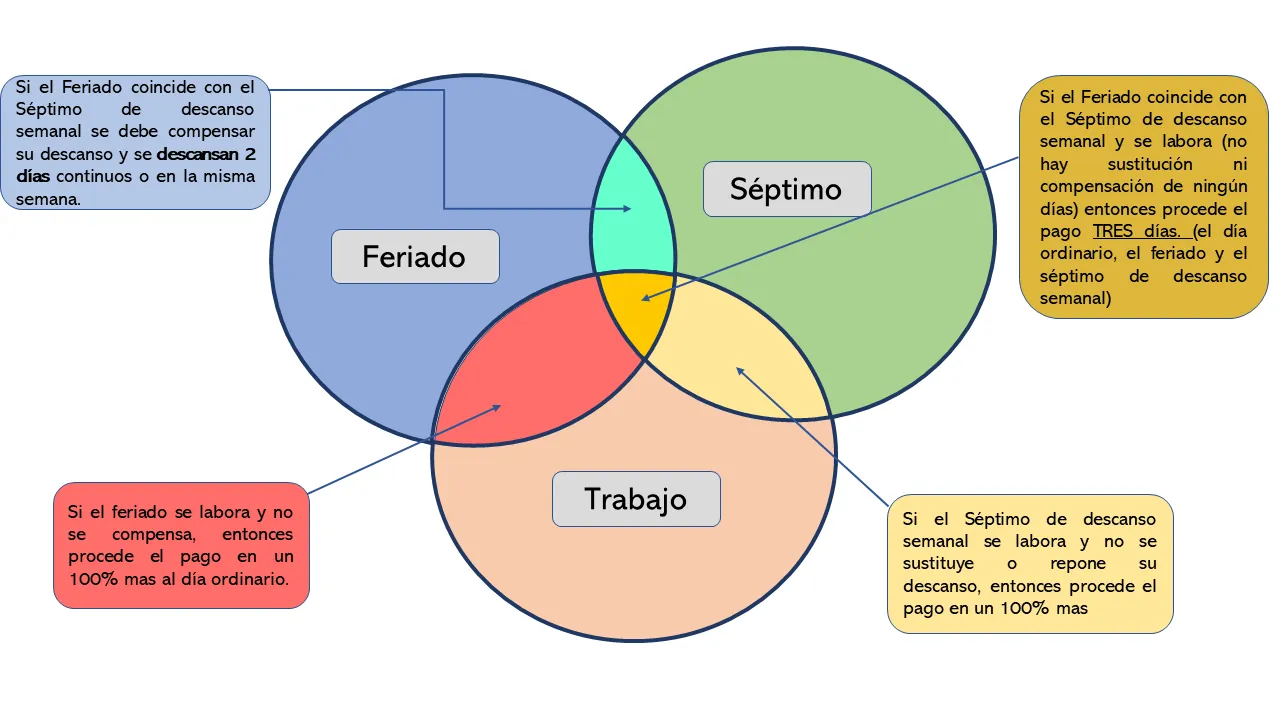
If the public holiday falls on the seventh day of rest, compensation of the rest day applies automatically, that is, the weekly rest day is moved to the immediately following day, since the enjoyment of one labor right (in this case the holiday) cannot diminish or obstruct the enjoyment of another labor right (in this case the seventh day of rest granted by Article 64 of the Labor Code). In this case we are dealing with TWO continuous days of rest, and the following may happen: the worker works on the holiday without compensation with another day of the week. In that case, the worker would earn the wage for the holiday worked and also the wage for the seventh day worked that was not compensated, adding up to THREE days (the ordinary day, the weekly rest day and the public holiday). Clearly, the factual scenario for reaching this point is that the holiday falls on the seventh day of rest (Art. 68 Labor Code) and there is no compensation or substitution of the rest; that is, the worker worked on the day when this double overlap occurred without taking any rest.
For a clearer illustration, I prepared this three-circle chart showing the scenario or overlap required for holiday pay to apply.
5Conclusion
In conclusion, of the fourteen days on our labor calendar in Nicaragua, there are cases in which it is necessary or possible to work them in accordance with the Labor Code. In such cases there is the option of substituting the rest with another day, and of compensation when the holiday falls on the seventh day of rest; and when the day must be worked, there is the option of paying the holiday worked at one hundred percent more than the value of the ordinary day. If the double overlap occurs, where the holiday falls on the seventh day of rest and there is neither substitution nor compensation (that is, the day is worked), the payment must be triple: the ordinary working day, the holiday, and the seventh day of rest not taken.
⚠️ Legal Notice
This article reflects solely the personal and exclusive opinion of the author and does not necessarily represent the position of D’IMPACTO, S.A. The information provided here is for informational purposes only and does not constitute legal advice. For specific situations, please consult a labor law professional.
Do you have questions about managing public holidays?
Do you have concerns about how to manage your staff with these new public holidays?
Our labor law specialists can guide you in implementing appropriate policies for managing public holidays in your company.
Do you have more questions about how payment should be handled when these days must be worked?
We advise you on the correct calculation of pay for holidays worked, considering all applicable legal variables.
Did you know that this overtime payment is also subject to Income Tax on employment income and to the employee-employer INSS social security contribution?
It is crucial to consider these tax and social security aspects when processing pay for holidays worked.
Need professional advice?
At D´IMPACTO, S.A. we support you with tailored solutions. Contact us at +505 8645 4114 | +505 2772 4953 or write to us at atencionalcliente@dimpacto.com.ni.